
Lovins and Hummel, new Precourt scholars, bring beginner’s mind to radical energy efficiency
We can run our homes, skyscrapers, data centers, cars, airplanes and industries on radically less energy by rethinking design processes, while saving our climate and money, according to new Precourt Energy Scholar Amory Lovins.
Lovins and Rocky Mountain Institute, which he cofounded, have shown this is possible in hundreds of projects, thanks more to new designs than breakthrough technologies, as Lovins described in a special Energy Seminar at Stanford University in November with Holmes Hummel (BS/MS ’99, PhD ’06), also a new Precourt Energy Scholar. In addition to teaching several courses in the 2020–21 school year, the two adjunct professors in Civil & Environmental Engineering are excited to work with Stanford faculty and students to advance their design concepts and extend them to a new generation of engineers.
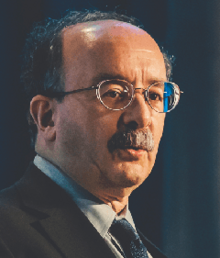
“Observing vehicles and factories and buildings in over 70 countries in 50 years, I see the same design errors repeated everywhere,” said Lovins. “So, I'm hatching a plot for the non-violent overthrow of bad engineering.”
Regardless of the application, integrative design for radical energy efficiency starts with shedding all previous conceptions and assumptions, and instead cultivating “beginner’s mind,” Lovins explained in the lecture. First, define the desired service. For example, the point is to cool people or materials, not buildings or equipment. Then, optimize the entire system, not just its separate parts. This can produce energy efficiency gains severalfold larger and cheaper than otherwise expected. Lovins also explained the virtuous circle of reiteration through design teams as efficiency gains in one component make others smaller, simpler, and less expensive—or eliminate them altogether. Greater efficiency can cost less, not more, because it uses fewer and simpler devices, not more and fancier ones.
Thus his 1983 home near Aspen has harvested 77 indoor passive-solar banana crops, yet needs no heating system—and was cheaper to build without it. Its pumping system used 97 percent less pumping power and capacity by adopting fat, short, straight, hence cheaper pipe layout. His quadrupled-efficiency BMW electric car pays for its ultralight carbon-fiber body by needing few batteries to haul the weight around.
Bend minds, not pipes
For buildings, this approach has yielded benefits in both new construction and retrofits. The 2010 energy efficiency retrofit of the Empire State Building cut energy use by 38 (later 43) percent, resulting in savings that paid for the investment in three years—and now the owner is targeting the next 40 percent. RMI’s 2015 office cut energy use by 88 percent—so it easily produces more solar energy than it uses—and, like Lovins’s similarly “net-positive” home, has no mechanical systems except ventilation heat recovery.
“The only obstacle is force of habit,” Lovins said. “We should bend minds, not pipes.”
U.S. end-use efficiency is about a seventh what it could be. Making integrative design as common as grass could profitably help close that gap, said Lovins, whose lecture provided results from projects to redesign diverse buildings, road and air vehicles, industrial plants, and a data center. So, he said, the energy transition could move at the pace and cost of design and software, not of infrastructure.

Hummel described the 2020-21 academic year as an extraordinary opportunity for Lovins and the Stanford energy community to interact. At least in the near term, the two scholars embrace the opportunity for online, virtual learning to increase the number of students able to take their classes.
“Even in troubled times,” Hummel said, “we are seeing spectacular opportunities emerge from the convergence of movements for social justice and the survival instincts of a generation that is resolved to exponentially increase investment in clean energy solutions for all.”
Teaching and research
Lovins and Hummel taught a course on whole-systems thinking for energy solutions in the autumn term with Jane Woodward (MS/MBA ’87), managing partner at MAP Energy and adjunct professor at Stanford since 1991. Hummel also co-taught a course on racial equity in energy with faculty member Rishee Jain and lecturer Anthony Kinslow (Phd ’18). Hummel, founder of Clean Energy Works, has worked for a decade on finance mechanisms to accelerate investment in distributed energy solutions—like solar power—without regard to a customer’s income, credit score, or renter status.
This winter, Lovins and Hummel will teach the course Extreme Energy Efficiency (CEE 107R/207R) with Diana Gragg, managing director of the Precourt Institute for Energy’s new Explore Energy program. In the spring term they will teach a course probing how to deploy integrative design on a broad scale. A summer practicum will start testing some of the solutions developed. Hummel will offer a course on inclusive financing solutions for accelerating the clean energy revolution.
In addition to teaching, Lovins and Hummel are researching topics in energy efficiency and energy equity during this year. This is in keeping with Stanford’s vision of eliminating the lag time in translating knowledge into solutions and speeding the transfer of those solutions beyond the campus.
“I can't wait to get Stanford students, faculty and everybody that wants to play engaged in this,” said Lovins.
Starting in 1978, Stanford has hosted Lovins for numerous teaching and visiting lecturer engagements, including his post as a MAP-Ming visiting professor in 2007.
Lovins is the cofounder (1982), chairman emeritus and a trustee of Rocky Mountain Institute and was RMI’s chief scientist from 2007 to 2019. With more than 280 full-time employees, the non-profit, non-partisan institute works with businesses, governments, researchers and others to accelerate the adoption of market-based solutions to shift from fossil fuels to energy efficiency and renewable energy. Lovins continues to collaborate with RMI, complementing his work at Stanford.
“I hope my dual role will strengthen cooperation between Stanford and RMI,” said Lovins. “During spring term next year, for example, RMI and I will teach the intensive course Extreme Energy Efficiency to Stanford students for the fourth consecutive year.”
The weekly Stanford Energy Seminar is taught by Prof. John Weyant during the autumn, winter and spring terms. It is sponsored by Chevron.
Explore More
-
The Stanford Doerr School of Sustainability hosted the Stanford alum and electric vehicle entrepreneur for a Big Ideas series discussion about how entrepreneurship can change the world.
-
New reports detail how faculty, students, and scholars came together from across campus to generate sustainability solutions.
-
Jay Precourt has stepped down as co-chair of Stanford’s Precourt Institute for Energy Advisory Council. Ira Ehrenpreis has taken over as new co-chairman with Michael Morgan.


